Hides are still softened and dyed in stone vats in the middle of the medina, and the men who do it start before the tour groups arrive.
01. What Chouara is
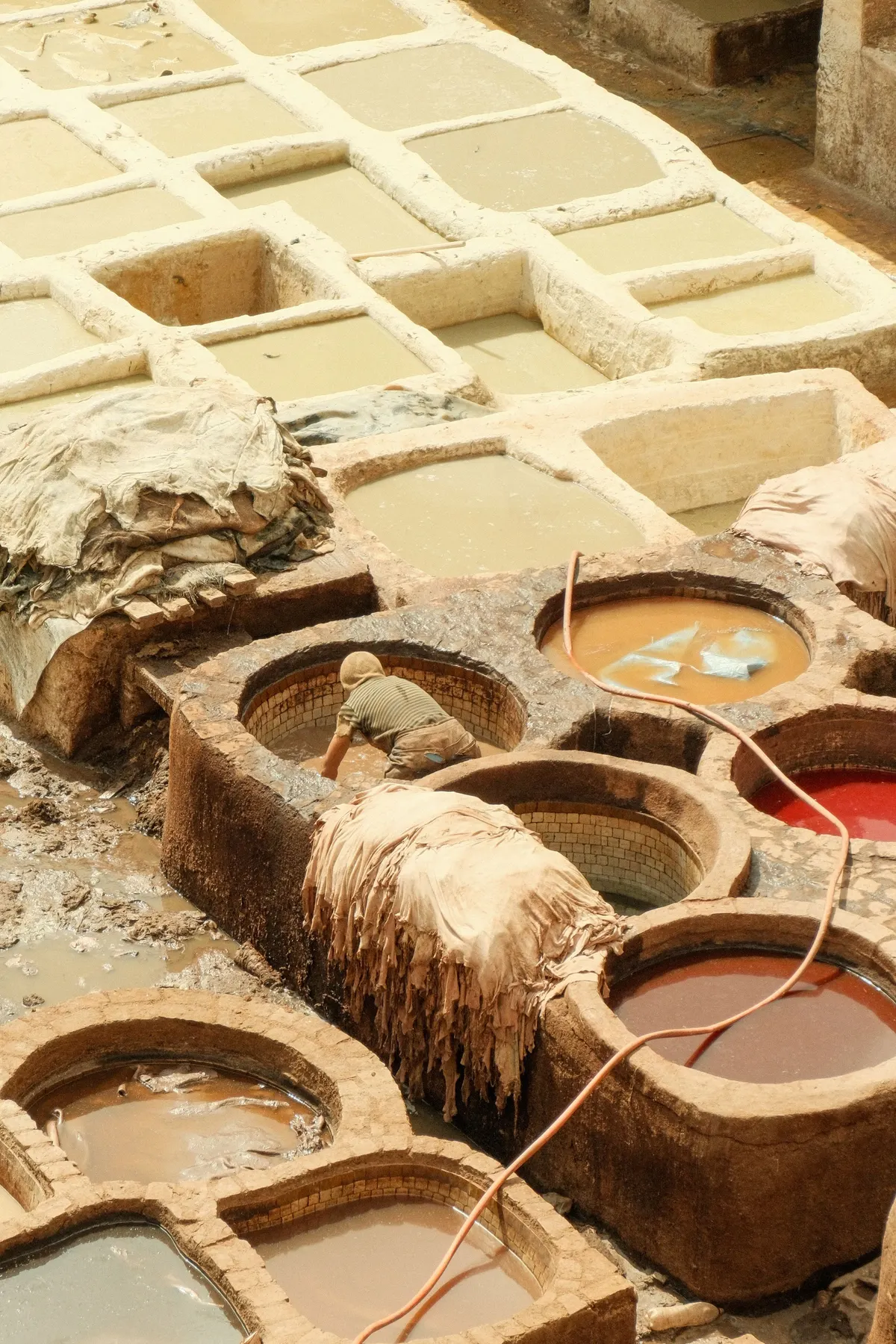
Chouara is the largest of the three tanneries still working inside the Fes medina, in Fes el-Bali along the Oued Fes. It is not the oldest: nobody has dated its foundation with any confidence, and the 'oldest tannery in the world' line you hear on the terrace is a sales argument. The tanneries of Fes are documented from the twelfth century on, and Sidi Moussa, up in Guerniz, is the one named in the Rawd al-Qirtas.
It is not a museum reconstruction. The work happens every working day, largely unchanged: hides go into the softening pits, then into the dye vats, then up onto the terraces to dry in the sun over the rooftops of the souk. Around 800 tanners still work in the city, roughly 45% of Morocco's total, and leather is about 40% of Fes artisan turnover.
02. How the tanning works
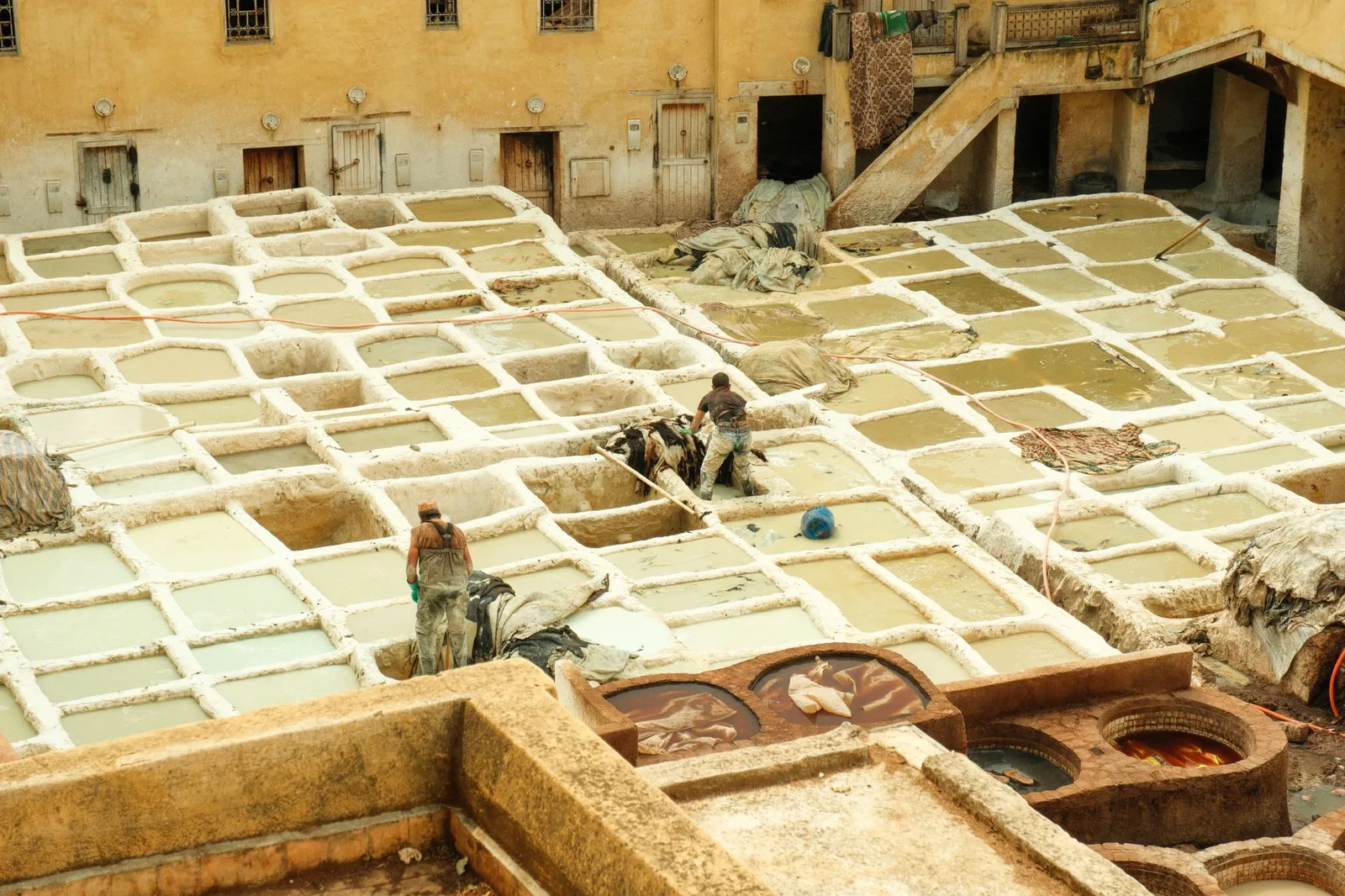
The first stage is the pits of water, limestone and pigeon droppings, whose ammonia softens the hides — this is the source of the smell the tannery is famous for. Skins sit there for days, turned by hand by workers standing waist-deep in the mixture.
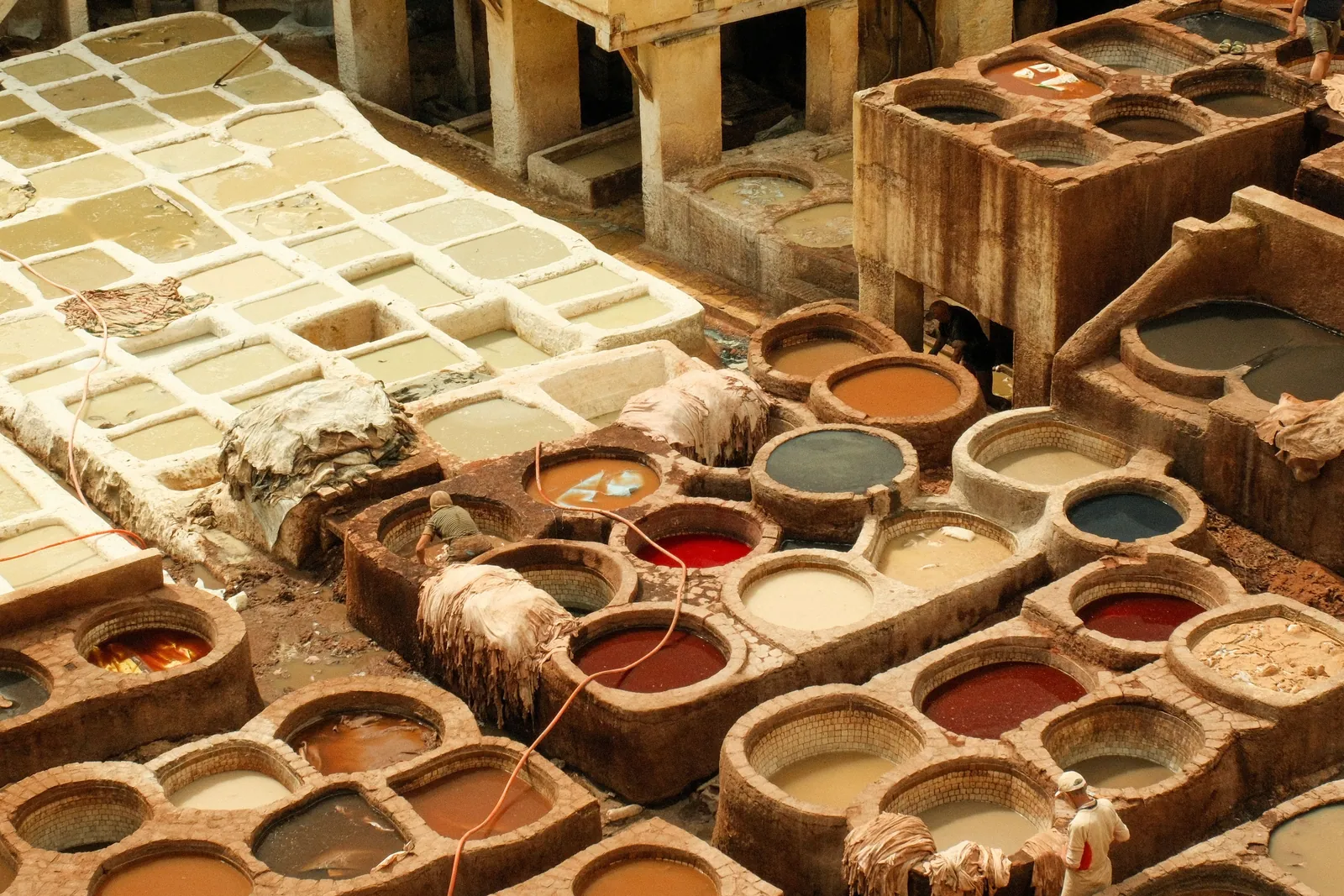
Then the dyes. The colours traditionally come from plant and mineral matter — poppy for red, indigo for blue, henna for orange, saffron for yellow — and the hides are trodden and soaked until the colour holds. What you see from above, the honeycomb of round vats in ochre, white and primary colours, is this stage.
The 'all natural' story needs a caveat. Chrome tanning reached Morocco in the nineteenth century and is standard in the modern tanneries on the edge of the city. The three traditional houses in the medina were ordered to stop using chemicals by a municipal decree of 21 April 2015, and the restoration that followed — 75.5 million dirhams across Chouara, Sidi Moussa and Aïn Azliten — was partly about making that order real. Some leather sold around the vats is tanned the old way and some is not. Ask, and do not assume.
03. How to visit it
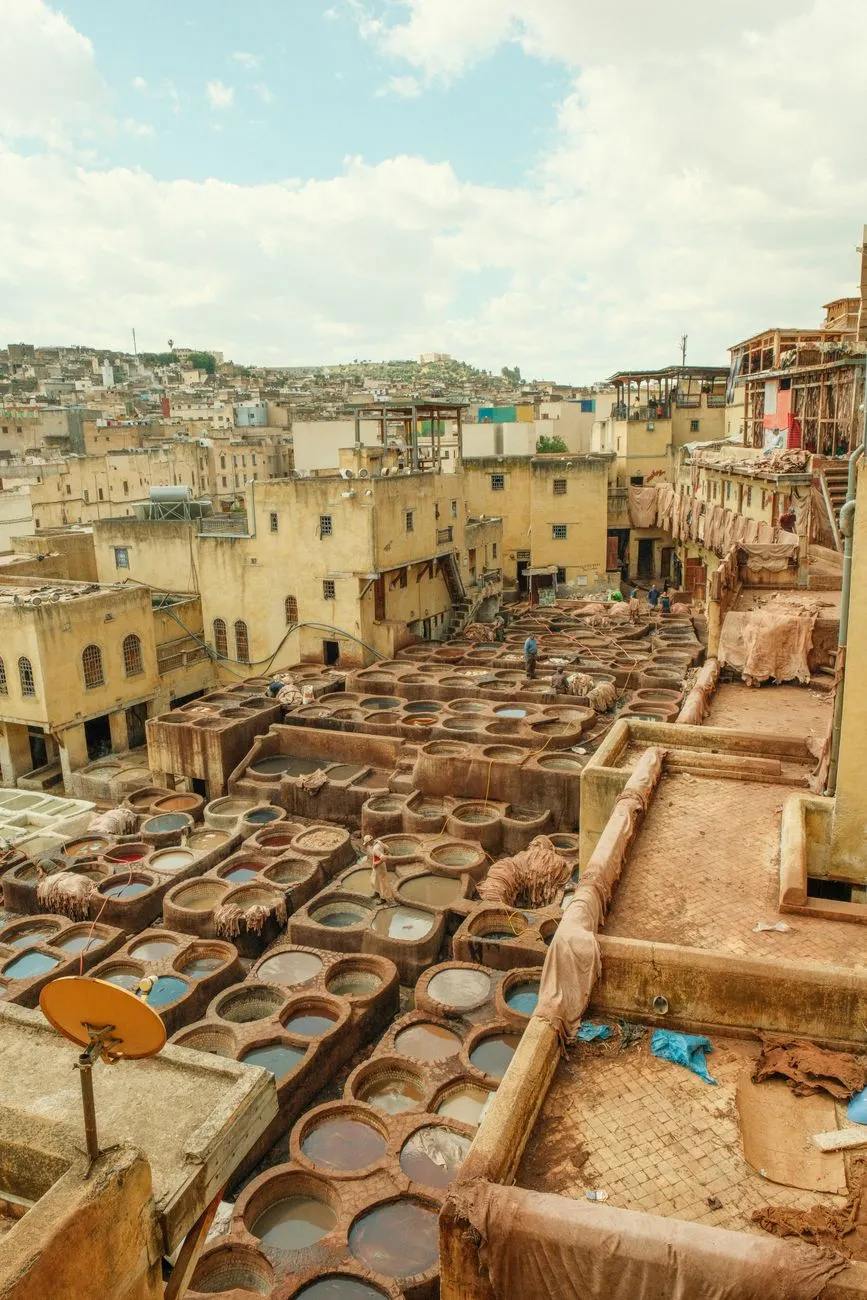
There is no entrance, no ticket booth and no official opening time. The tannery is viewed from the terraces of the leather shops that surround it: you walk into one of the shops, someone takes you up to the terrace, and the whole honeycomb opens below you.
The viewing is free in the sense that nobody sells you a ticket, but the shops are businesses: expect to be shown leather afterwards, and either buy something you genuinely want, leave a small tip for the terrace, or decline politely and walk down. You are under no obligation to buy anything.
04. The smell, honestly
It is strong, and no description prepares you for the full amount of it. The pigeon-dung pits are the source, and they sit right below the terraces. Shops hand out sprigs of mint to hold under your nose, which helps for about a minute.
The standard advice is to breathe through your mouth and not to fight it — within a few minutes your nose gives up and registers almost nothing. People who have come expecting it tend to find the visit genuinely fascinating; people who arrive without warning tend to leave quickly.
05. When to come
The terraces open with the shops, roughly 9:00 to 18:00 daily, slower around Friday midday. There is no official schedule — the tannery works whether you show up or not.
For photographs and atmosphere, late morning to mid-afternoon is best: the sun reaches into the vats, the colours saturate and the workers are busiest between about 10:30 and 15:00. Early morning light is soft but half the vats sit in shadow; after about five the workers start to leave.
06. Buying leather
The terraces are inside leather shops and the connection is not subtle — the same stairway that gave you the view delivers you into a showroom. Fes leather is real and good, and the tannery district is one of the few places where you can buy directly above the workshop that made it.
Bargaining is expected on anything without a fixed price, and quality varies between shops. If you are not buying, say so at the top of the stairs rather than after the tour of the showroom; a polite no in French or Darija closes the subject.
07. Quieter alternatives
Chouara is the famous one and the busiest. Two other traditional tanneries still work inside the medina: Sidi Moussa, in the Guerniz quarter near the Zawiya of Moulay Idriss II, and Aïn Azliten, in the north of the medina — the newest of the three, created at the end of the eighteenth century, and the smallest. Same process, a fraction of the crowd.
Ain Nokbi is a different thing and not a substitute. It is the artisan pole outside the walls where raw hides are sold and where the polluting river work was moved out of the medina. There is no terrace to climb.
For most visitors Chouara is still the right call: it is the one you have seen in every photograph of Fes, it is in the middle of the medina walk, and the honeycomb of vats is the most complete view in the city. Just go at the right hour rather than at eleven with everyone else.
08. Common mistakes
The first is treating it as a photo stop from the nearest terrace and leaving in five minutes. Twenty unhurried minutes teaches you what the process is; five minutes gives you the postcard.
The second is being walked into a shop you did not choose. The terraces are all private; if the first shop's hard sell puts you off, come down and try another entrance. The third is touching the vats or leaning over the walls — the workers are in the pits below, and this is their workplace.
Frequently Asked Questions
Is the Chouara tannery free to visit?
Yes — there is no ticket. You view it from the terraces of the surrounding leather shops; a small tip for the terrace or a purchase is the unwritten expectation, but nothing is compulsory.
What are the opening hours?
There is no official schedule. The surrounding shops and terraces are generally open about 9:00 to 18:00 daily, quieter around Friday midday.
What is the best time to go?
Late morning to mid-afternoon, around 10:30 to 15:00, when the sun reaches the vats and the workers are busiest. Bring a camera with a zoom if you have one.
Do visitors go into the vats?
No — visitors watch from the terraces above. The tannery is a working industrial site, and the pits belong to the workers.
How bad is the smell?
Strong, from the pigeon-dung softening pits. Shops offer mint sprigs; breathing through your mouth and giving yourself a few minutes works better than fighting it.
More Morocco tours
9 Days
9-Day Morocco Tour from Casablanca
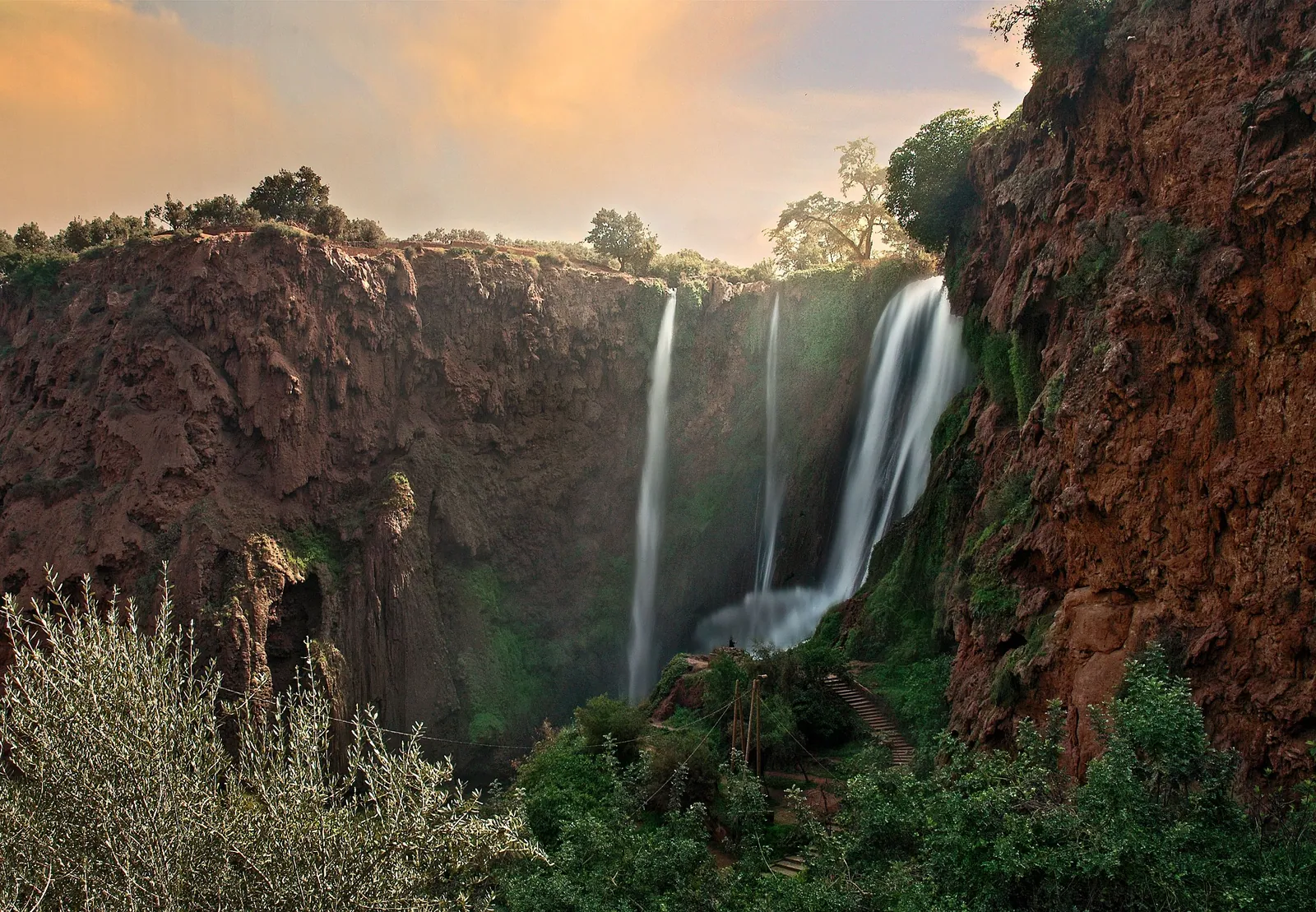
From Casablanca over nine days through royal cities, ancient medinas and a stretch of desert. Long enough for the three settings to breathe, short enough that the trip never becomes a transfer schedule.
10 Days
10-Day Morocco Tour from Casablanca
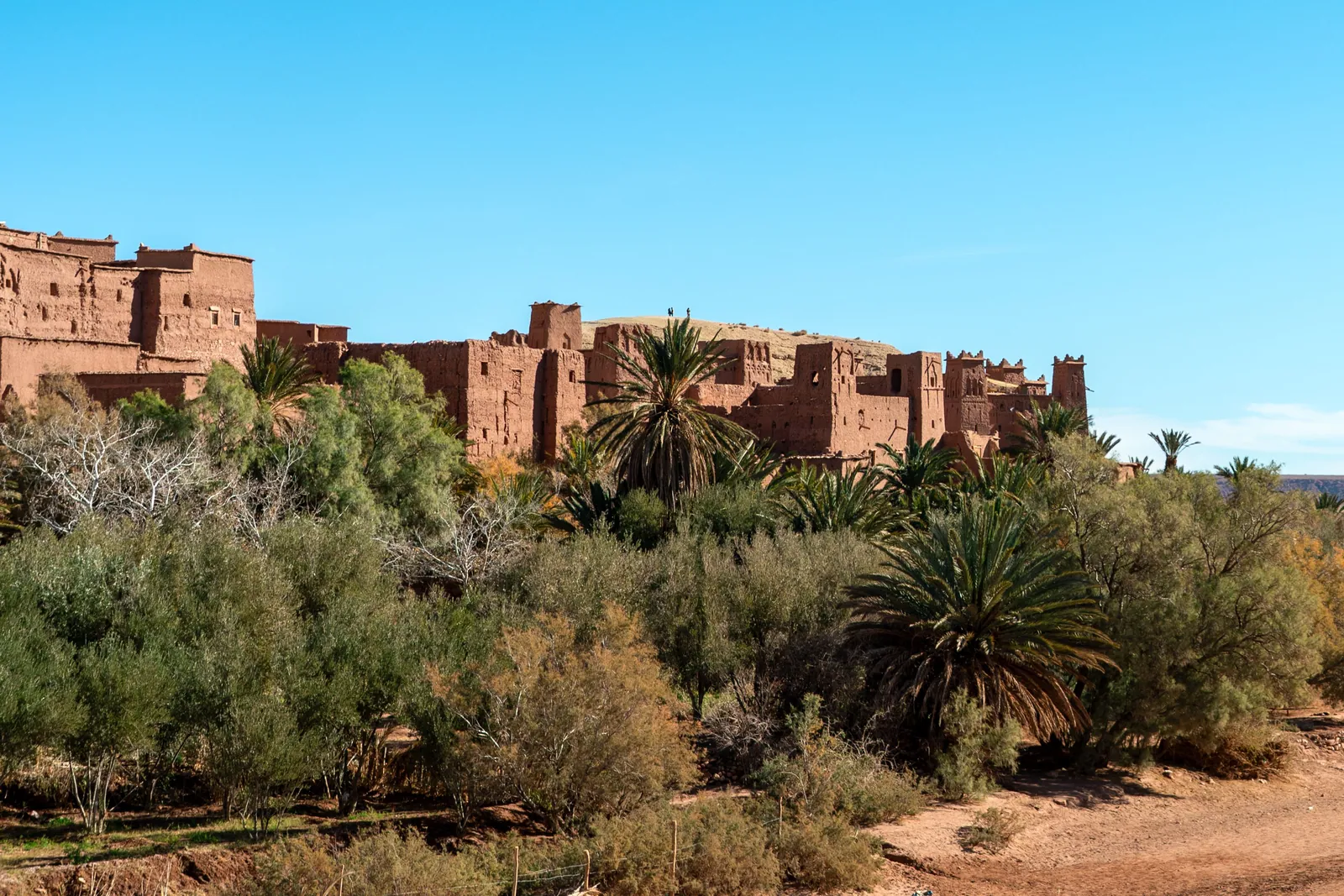
Ten days from Casablanca through imperial cities, mountain villages and desert. Built for range rather than one region, with three different settings spaced out so no two days look alike.
7 Days
7-Day Morocco Itinerary: Fes, Chefchaouen and the Sahara
Seven days with the tanneries of Fes, the blue walls of Chefchaouen and a night on the Sahara in the same week. It works because Chefchaouen sits between the two rather than off to one side.
Related Guides
Fes Travel Guide 2026
The complete guide to Fes: the world's largest car-free medina, the Chouara tanneries, madrasas, what to eat and where to stay in Morocco's spiritual capital.
Jemaa el-Fna: How Marrakech's Square Actually Works
Jemaa el-Fna is Marrakech's main square and a UNESCO-listed living heritage site. How the day and night versions differ, how the food stalls work, what things cost, and how to enjoy the square without getting hustled.
El Jadida Travel Guide: Portuguese Cistern, Walls and Atlantic Coast
El Jadida and its walled Portuguese city of Mazagan: ramparts, harbour and Atlantic beaches. The cistern has been closed since 2021; what to see instead.
Liked this guide?
Give it a like on Instagram and tag us from your Moroccan adventure.
Ask us how the Fes tanneries fit into your medina day
Our Marrakech-based team of local experts designs tailor-made Morocco trips around your dates, budget and travel style.
Request a Quote